
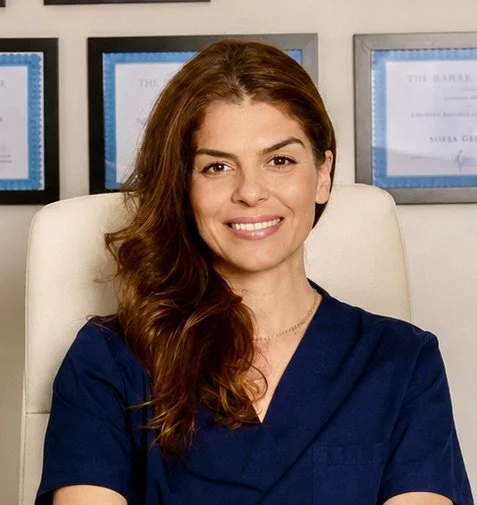

Sofia Georgiou
Sofia’s work has always been shaped by two parallel interests: the human body and the voice.
METHOD
Creator of BodyVoice Synthesis® - Integrating physiotherapy, movement sciences, manual therapy and exercise selection for professional voice users
EDUCATION
Sports Science, University of Athens
MSc Sports & Exercise Physiology, LMU Physiotherapy, University of Bradford
Visceral Osteopathy
Acupuncture
TEACHING
Postgraduate teaching at Medical University of Athens
International Workshops
Two Parallel Paths
Her professional journey began with Sports Science at the University of Athens, followed by a Master's degree in Sports & Exercise Physiology in Leeds, UK. Her research in cardiac rehabilitation deepened her interest in how the body adapts to physical demand and recovery, eventually leading her to study Physiotherapy at the University of Bradford, UK.
Alongside this scientific and clinical path, voice and performance were already an important part of her life. She trained in singing and performed as a vocalist in a band, developing a personal fascination with the relationship between movement, posture, breathing, expression and voice.
When Sofia later experienced muscle tension dysphonia, she began to connect her clinical understanding of the body with her personal experience of voice. She started looking at the voice through everything she already knew about the body: movement, biomechanics, muscular tension, breathing, exercise and the body's adaptations over time.
What began as a personal exploration gradually became her professional focus.
Working With Performers
Over the years, Sofia’s work with professional performers revealed recurring physical patterns behind vocal difficulty. Previous injuries, movement and postural adaptations, breathing mechanics, muscular tension and fascial relationships often appeared to influence the conditions in which the larynx was being asked to function.
These clinical observations gradually shaped a broader way of understanding voice - and became part of the foundation of Body Voice Synthesis®.
The larynx belongs to a body.
And that body has a history.
Today
Today, Sofia brings together clinical practice, Body Voice Synthesis®, academic teaching and international professional education.
Her work is shared through clinical practice, postgraduate teaching, lectures, workshops, masterclasses and her book, Body Voice Synthesis® - Healing the Voice Through the Body.
Interested in bringing Body Voice Synthesis® to your institution?